

This is an excerpt from my book, The Nomad Life, available on Amazon.
November 2022
“Marbahan,” contorted from my lips, the first word I’d learn in Arabic class on our Suez Canal cruise to Saudi Arabia. By the time we arrived in the small port city of Yanbu, my total Arabic word count was five. Fortunately, the immigration agent just smiled, stamped, and waved us through to our 6-hour port stop.
Yanbu, a new port for the equally new cruise trade, hadn’t quite gotten its legs under itself as the world reopened post COVID. We meandered to its one tourist attraction, a recently developed recreation of an historic seaside. 18-inch square timbers jumbled with orange construction tape lay at the entrance, hinting that the re-creation wasn’t quite finished. Pink tropical scarves waved from white coral stone shops with windows framed by stained latticework, while hand-woven raffia baskets necklaced their doorways. Oddly, two classic American cars of light blue and fire-engine red staged the visitors center.
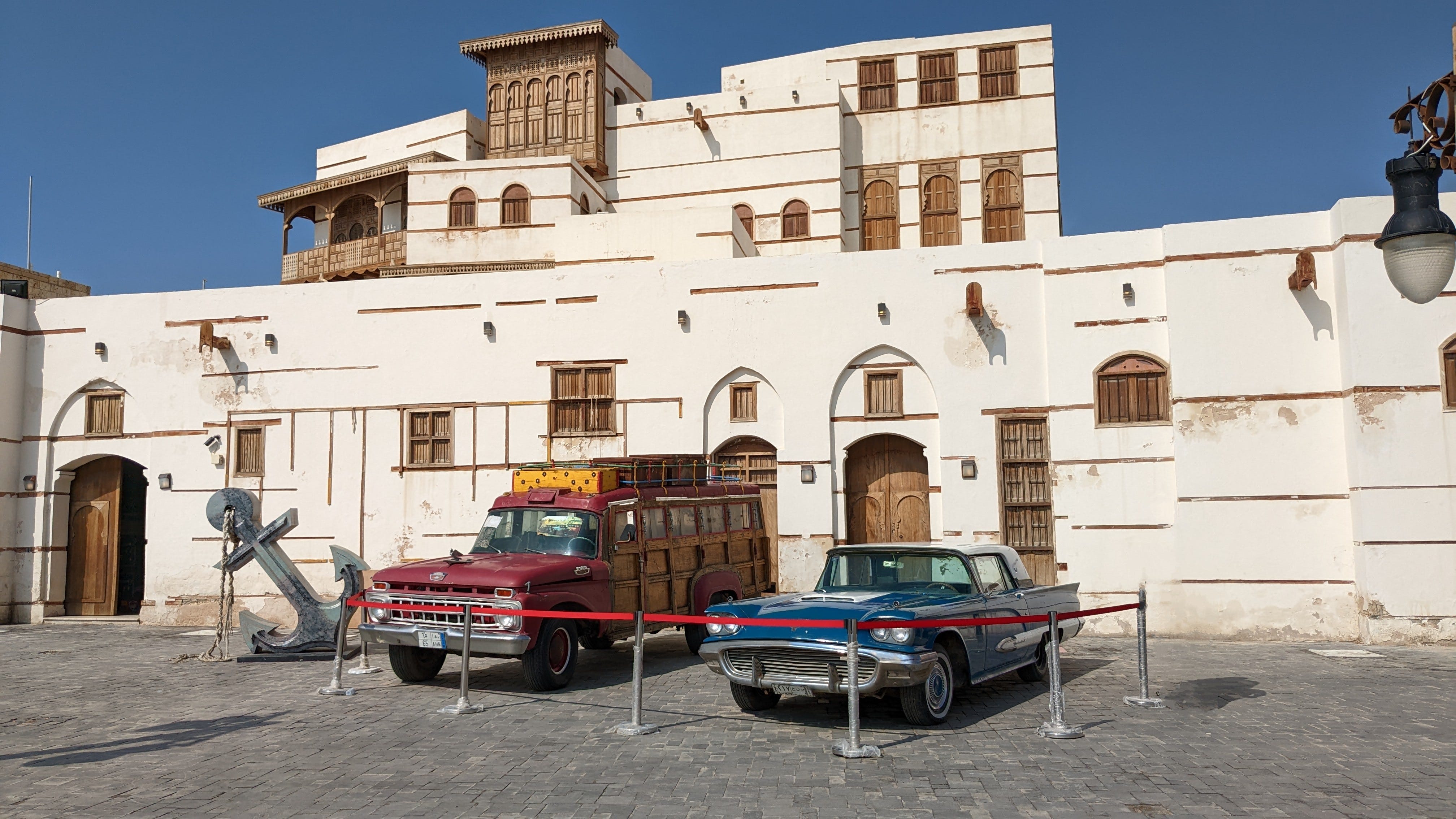
After an hour weaving through the waddling cruise passenger pack, we were bored and wanted a bit more from Saudi Arabia.
On the corner stood a man in his bright, white, thawb covering him from his shoulders to his feet; he motioned Steve, my husband, and me over.
“Where are you from, ha-bi-bi-ti?” he opened the conversation, addressing me as darling, another new word to add to our database.
As full-time traveling nomads, this answer is complicated. Afterall, we don’t own a house and we live out of our carry-ons. We’re never quite sure how our Americanness will get received; we hesitated, then replied, “The USA.”
“I love America!” he beamed.
“We love Saudi!” I replied. Thus began ten minutes of friendlies, where my internal red flag meter that sniffs out scammers went to bright green. Our kind local sincerely wanted us to enjoy his city. He was like me; I had played his role many times in my hometown, offering unsolicited help to tourists on the street. He suggested we grab an Uber and go for a ride.
“See my beautiful country,” he encouraged us.
Uber in Saudi? We’d used our favorite ride-share app around the world, but somehow never figured it’d be available in Saudi. With four hours until we sailed, we hailed an Uber from the app and hired a driver to take us to the one place we’d seen listed in Atlas Obscura.
Within a few minutes, Ibrahim slid up in his Uber car, a black Mercedes Benz GLA class SUV with tinted windows. Perhaps he was a bit confused, wondering about this non-Arabic couple who had hailed him. We slipped into the car’s lush leather seats, water bottles in holders awaiting passengers, and air conditioning blasting out the 100-degree heat. Realizing that it’d be more culturally aware for Steve to initiate our interaction with him, I settled in and watched the two of them greet and stumble through the Uber verification process that it was, us, in fact, who had hailed him.
Ibrahim nervously giggled about his first American passengers and said marbahan, or welcome. He pointed the Benz north out of town, away from the safety of our ship. With a death grip on the phone and my thumb cocked over the emergency button in the Uber app, I anxiously tracked every kilometer on the 20-minute route.
“What the heck are we doing?” I whispered under my breath to Steve. Why did we think jumping into an Uber in a country where we seriously did not speak the language, and did not know where we were going, was a good idea?
He grinned at me. “Having an adventure,” he replied, reminding me that this is what we always do in new countries. We escape the pack and delve in on our terms.
I relaxed.
As we left the city and began crossing the desert, we laughed through a conversation built around the five words we’d learned on the cruise that would get us back to the ship; yallah (go), saffina (ship), khamsa (five), shkran lak (thank you) and marbahan (hello). In addition, we had picked up our sixth, habibiti. Our driver knew another five words of English, and together, our 11-word vocabulary revealed that he had many wives, we had to be at the ship by 5, and thank you can go a long way.
“Oh my god, a camel! A camel!” I squealed. Out across the sand, under a palm, as if a child had drawn the scene, stood an untethered, wild camel cooling itself in the shade.
We’d seen camels as beasts of burden or in zoos, but never freely roaming in the wild. Ibrahim viewed us in the rear view mirror quizzically. Perhaps he couldn’t quite fathom why, what he considered to be equivalent to a stray dog, seeing a camel would be exciting. And we added another Arabic word to our vocabulary, jamal (camel).
We arrived at our Atlas destination where we expected to find a beautiful oasis filled with date palms, a bubbling spring, and a stand to buy snacks. Instead Ibrahim pointed to a dried-up palm leaning precariously over a dilapidated bench. Apparently, our reference hadn’t been updated since COVID had swept through this small town. The view also explained why Ibrahim had been reluctant to take us to our destination.
“Now what?” I asked Steve.
Disappointed, we hesitated to get out of our comfortable Uber. If we exited, would we be able to hail another to get back to the ship once we explored the area a bit more?
Our enterprising Ibrahim jumped in. Somehow, he put together a sentence with our combined 11-word vocabulary that he would “yallah ha-bi-bi-ti jamal.”
“I think he wants to take us to see darling camels?” said Steve.
Not quite sure of exactly what Ibrahim was suggesting, our ever-present, adventurous spirit signed up and buckled in. With three hours until our sail away, we trusted Ibrahim would get us back in time
He re-programed our destination in the Uber app, and we headed somewhat back toward the ship, tracking our route all the while. The concrete highway comforted us, giving us a “back home” feeling of safety with its familiar construction and flow of traffic. Things seemed to be moving smoothly as our trust built in Ibrahim’s promised adventure.
Nonetheless, we kept an eye on the route just to be sure we’d be within rescue distance from the ship if things went wrong. We sat back in the cushy leather seats, enjoying the cool bottles of water.
Then all of a sudden, our trusted Ibrahim took a hard right off the concrete road, onto the sand, into the desert, and away from the ship.
I whispered to Steve, “And this is when we die.”
The Uber app started to spin, having a tough time locating where we were and where we were going.
Seeing our anxiety and our squirming bodies, Ibrahim turns around and restates, “Ha-bi-bi-ti camel, please.”
100 yards later, Ibrahim stops the car, gets out and opens my door.
He motions that we should walk toward the railing we see 50 feet away.
The sand crunches under my feet on the firm ground. A dry heat simmers my skin, and my nose picks up the scent of vastness, empty and deep. I’m sure I’ll find venomous snakes and poisonous scorpions as we approach our target.
We place our hands, waist high, on the slightly rusted railing which is supported by wooden posts painted white, 3 inches square. Another railing runs parallel, but 20 feet away, inside from where we are. On the ground, a 10-foot-wide path of round, dinner-plate-sized footprints press into the sand. In the far distance to our left, we glimpse a finish line of this giant, 6-mile long racetrack. In the center of the course we see freely-grazing, prized camels awaiting their next race in a few days.
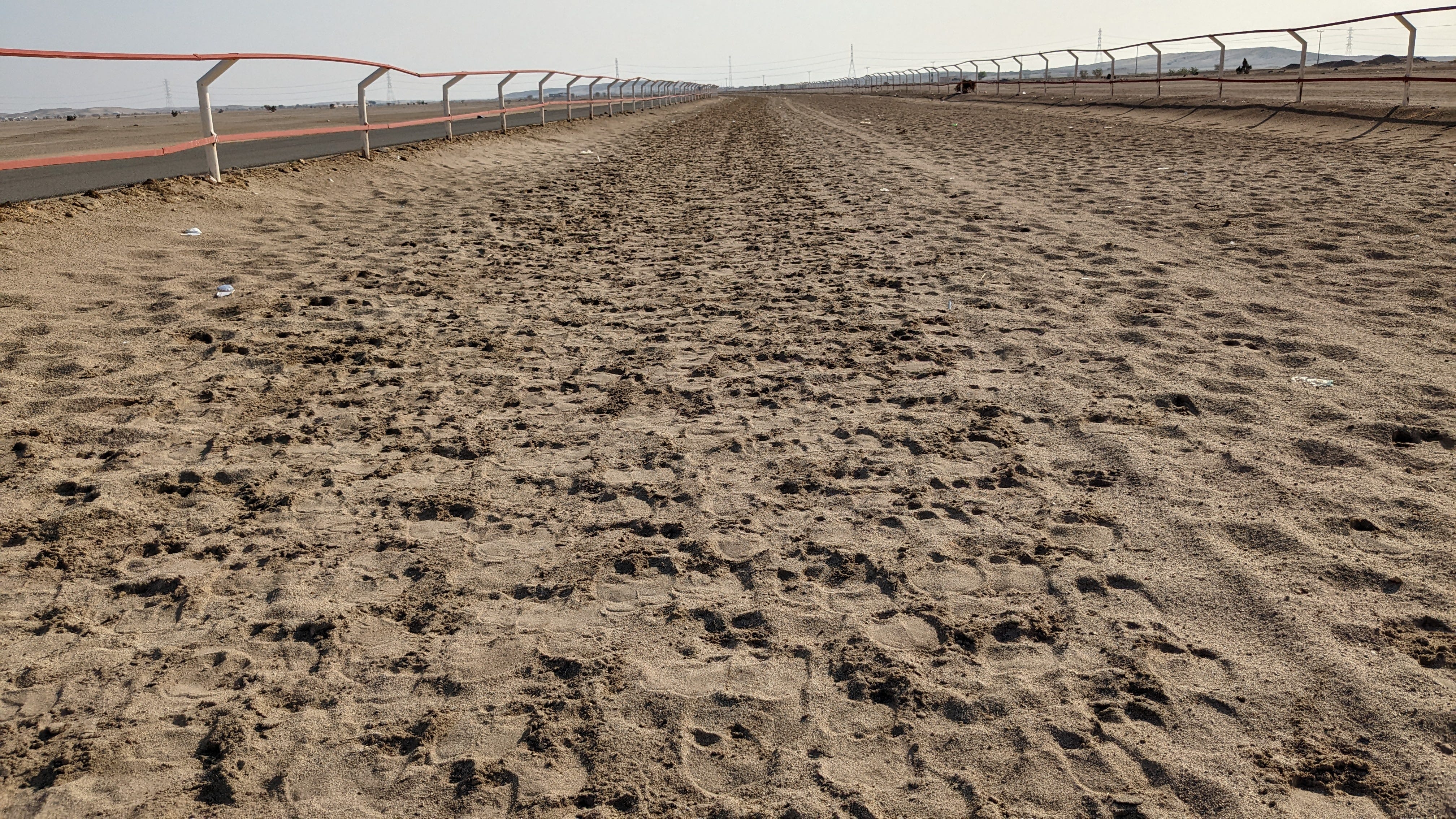
Ibrahim had taken us to the camel races!
Green banners announce in white Arabic letters the date of the next day of racing. Sadly, we can’t wait three days for the excitement.
We get back in the Mercedes and, this time, Ibrahim drives across the sand toward a complex of three separate areas, each one squared off with solid black, nylon cloth. Three men in their white thawbs and red keffiyehs walk out of one of the areas, greet us, “as-salamu alaykum”, motioning us to come inside.
We cautiously walk forward, our trusty Ibrahim with us. I hold my phone in my hand so Uber could still track our excursion, mentally noting it’s an hour’s ride back to the ship. The men smile, gesturing to us and occasionally dropping an English word into the conversation, increasing the seven vocabulary words to ten to include home, buy, now.
“I think we’re getting a home tour,” I said to Steve.
“Does it come with the camels?” He joked to me.
The first model home of open-air, Bedouin tents came with walls, no ceiling, and a compost-style toilet. The second slightly larger home at about 400 square feet included layers of thick, red carpets for flooring. The largest 500 square foot home included a makeshift kitchen with a sink and a fire pit. Who could say no to the flexible, nomadic style of Bedouin-style living?
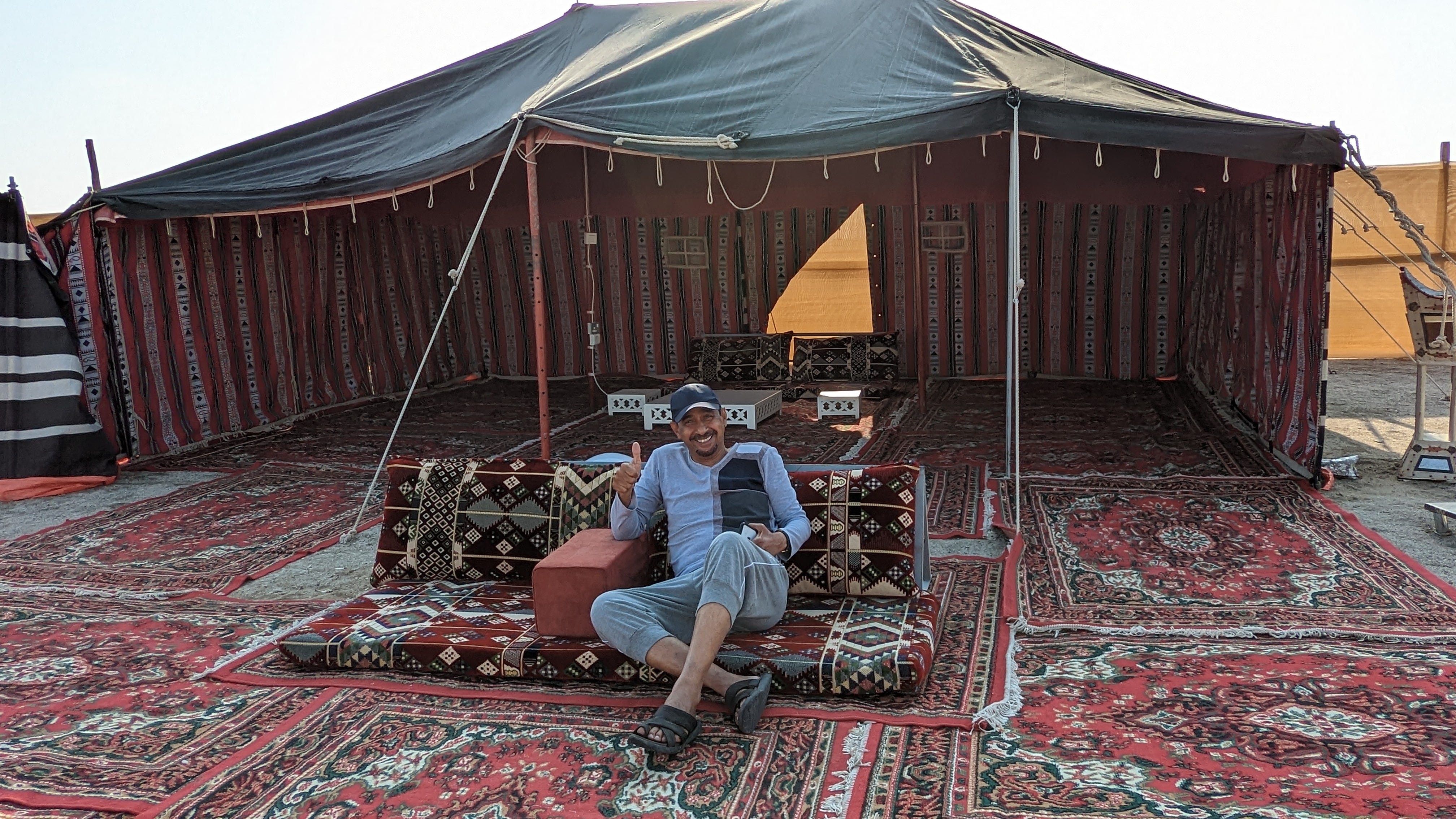
Some chit-chat bounces between our hosts. Then the man, who we think is the lead realtor, turns to us and grabs a stick on the ground. He writes the number $800 in the sand. For one year’s rent, we could get a finished home for $800 with a view of infinite sand dunes and roaming camels!
Today only.
Appreciating the amazing offer, we graciously decline their invite to join the community. We weren’t quite ready to set up more permanent housing.
Five o’clock fast approached; we mimed to Ibrahim that it was time to go. We loaded back up in the Mercedes. Our trusty Uber driver quickly and safely returned us to the ship, stopping along the way to buy us a snack of peanut nougat from a vendor at a streetlight.
With gas at only $.45/gallon, our Uber total summed to $15 after over 4 hours together with Ibrahim. Riding through the desert to visit camels and Bedouin homes certainly wasn’t how I had envisioned our port stop would go in Saudi Arabia. Maybe on our next visit when we don’t have to catch the saffina, we can yalla to the jamal races with our new ha-bi-bi-ti friends?
If you enjoyed this excerpt, there are dozens of more stories in my book, The Nomad Life. Won’t you grab a copy today?