

Transportation as a Strategy
As we make our way successfully through our lives, we carry toolbelts of skills and objects to help us navigate the world. Nomad Life is no different. To be successful as a full-time traveler, you’ll need to master these tools. In a series of newsletters, I’ll share a breakdown of these tools, starting with Transportation.
Nomad life is all about movement, everything from getting to the grocery to getting to the next continent. Whereas in your previous life, you may have used cars and planes, in Nomad Life the transportation wheel has many spokes.
Walking As Life
The wheel starts with your ability to walk more than you probably have ever walked. A 10,000 step day in Nomad Life is de rigor. Not just once a week, but every day. You’ll need shoes that support your great step counts and legs that are conditioned to do the movement. The number one piece of advice I give nomads beyond circling a date on the calendar to get your launch going is to get your body moving. If you’re not walking 5000 steps a day, start now.
How do you start in a life that’s super busy? Add walking into the things you’re already doing;
park further away,
walk the long way to get your mail,
walk to do an errand that you normally drive.
Every new steps counts toward grand totals. The more you walk now, the more you’ll enjoy Nomad Life.
Get Your Shoes Right
Regarding shoes, Steve and I each carry three pairs of shoes.
One pair is for athletics (pick your favorite sport and buy for it (such as hiking, tennis, or running.)
Our second pair is for general use (read review.) It’s also waterproof for rainy days in town, walking on the beach, or easy hikes across streams.
Our third pair differs. Mine is an all-around sandal that I use for dress up days on cruises, to wear with dresses, or as a quick shoe to put on to run an errand. Steve, on the other hand, uses his luggage space for a pair of water shoes. He doesn’t like to use his “all around shoe” in the water, even though it is water-friendly.
The Beauty of a Bus
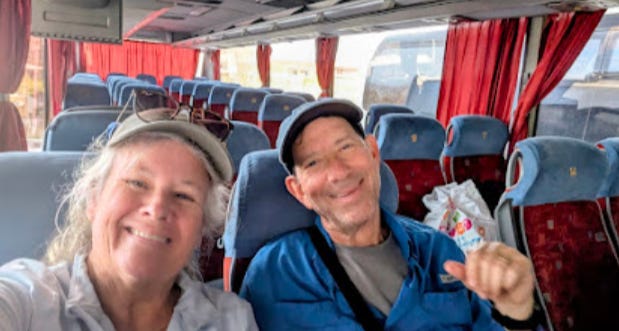
After your feet, busses/trams/subways become your next most used item to get around. If you’ve never been on a public bus or a subway, start practicing now. What’s this mean?
Learn how to use Google’s gps/maps software to find schedules and routes.
Do a practice run to a familiar location where you normally drive.
Get lost in the system.
Learn how to pay.
Understand how to track your ride so you know where to get off the bus.
And don’t forget to learn about downloading your maps offline so that if you lose connection, you don’t get lost.
If you’ll be in an area for more than a few days, be sure to check for multi-day passes, monthly savings cards, and tap-n-pay options. For the first time you take a bus ride, be sure to have small change with you in case you end up having to pay cash. Don’t assume the bus driver will have change or that your tap-n-pay will work. Be proactive with cash so you don’t get stuck.
Don’t Use Taxi, But Learn How to Hail an Uber
As a safe medium between transit and long-distance busses, you might find yourself needed a cab. If possible, use a car share app to get your ride. If you’ve never used Uber, Lyft, Bolt, Didi, or other similar apps, practice with them before you leave. They all work roughly the same. It’s important to know:
how to hail a ride,
pay for it,
track it, and
get help.
We avoid taxis. Period. And it goes without saying, but I’ll say it anyway, if the meter “is broken,” don’t even get into the cab.
The Lovely Train
Once you’ve mastered local transit and Ubers, your next transportation tool is the train or long-distance bus. Never taken Grayhound or Amtrak? Plan a short weekend trip using their routes to create an experience. I will say that international experiences on long-distance busses and trains vary greatly, but learning how to use these tools in the comfort of your own country will ease some confusion in the future. You’ll learn
how to find your platforms,
where buses come into large terminals, and
how to establish comfort onboard.
When taking a multi-hour bus or train, don’t assume there will be toilets and/or snacks. Come prepared. Also, carry some toilet paper with you and a paper towel or two. You may be pleasantly surprised with working toilets and ladies who board the bus at rest stops to sell you local treats. Or not.
You Don’t Know Everything about Flying
In this day, I can’t imagine no one hasn’t flown, but it’s certainly possible. Either book your first flight, or if you’ve flown, try something different.
If you’re used to one particular airline, try a different one.
Go to an airport you’ve never been to before
Try a day navigating an extra large airport
Measure your luggage and map it to the requirements of your new airline.
Test out your ability to get around an airport moving everything you own.
Is it too much?
When you purchase your flights (or any tickets for that matter), make sure you use a credit card that has travel insurance attached to it. If your flight cancels or gets interrupted, you can file a claim to be compensated for out-of-pockets costs, including those incurred for lost luggage. A good credit card with these types of benefits can be worth the annual fees (in this case it’s $95 for a Chase Sapphire card.)
Cruises that Cross Continents
For jumping continents, consider taking repositioning cruises. You may have vacationed for a week on a Bahaman cruise, but what about a 15-day cruise across the Atlantic to get to Europe? Look at the annual geography of the cruise industry as a whole. The entire industry moves its fleets twice a year, generally in the spring and fall (April/October.) These one-way cruises often cost less than the prices of a flight plus hotel and food. As Nomads, you’ve got time, why not try a slower way of getting around the world?
Do You Really Want to Drive?
Finally, let’s talk honestly about renting cards, motorcycles, and hiring drivers. Car rentals internationally can be quite stressful, quite costly, and quite dangerous. We avoid international car rentals as much as we can. On a 6-week trip through Europe, we leased a car which also included insurance. Since our medical insurance doesn’t cover us for motorcycles and scooters, we don’t use them (check yours!). As for private drivers, they can be absolutely worth it. Find them by
asking an Uber driver if they drive privately (verify insurance),
using a website like gettransfer.com, or
asking for recommendations in Facebook groups that cover the area where you’ll be traveling.
If you liked this post, I’ll be glad to break down currencies (cash, points, and rewards.) Would that be something you’d like to read? Let me know.
hey Chris, these are great pieces of advice regardless of a full-time, nomad or not.
I so agree with your tip about being fit for walking!! I get that I'm extreme but I am that committed to walking that I don't even do the bus, train or uber unless I really have to. There's something about feeling each cobblestone and smelling each flower (& fume) that adds to the experience. I'm paranoid about missing anything. I also love the fact that I'm fit enough to tackle any activity that comes my way.