

Many times I’ve sat around with friends and solved all the worlds problems. Clearly, though, we’re not in charge and therefore, the problems continue.
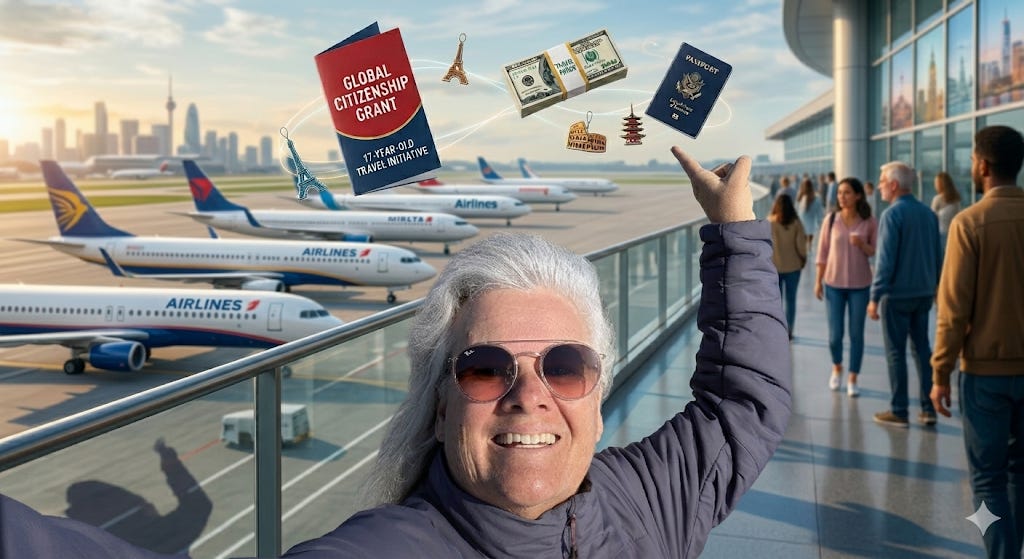
But within the framework of these round-abouts, I always share my dream with my friends. And I use “wave my magic wand” terminology. But as Monica Goh wrote in her wonderful piece I mention below, I thought it was time for me to share my dream to a larger audience beyond my cohort of problem-solving friends.
I’ll get to my dream in just a second. Let’s look at some statistics first.
4.39 Million 17-year Olds in the USA
There are 4.39 millions 17-years olds in the USA. Roughly half of them have passports. I asked AI to look at two data points globally. Some caveats expressed noted that Europeans don’t need passports to go to other EU countries within Schengen, thus their need to have a passport to “go abroad” isn’t needed unless they leave Europe’s Schengen zone.
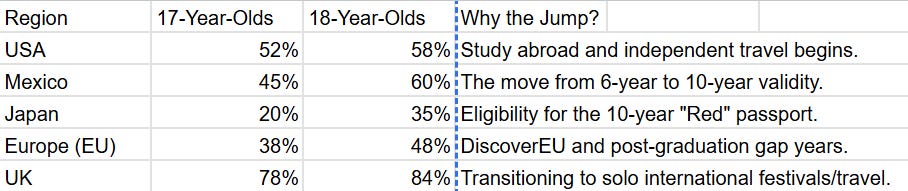
I thought it’d be interesting to look at the jump in passport ownership between 17 and 18 year olds. The reason for the jump is also interesting. (The sources for these numbers came from a combo of Wikipedia and Embassy data.)
Let’s return to the USA 17-year olds. Of those who have a passport, only about half of them actually have used it for travel (source.)
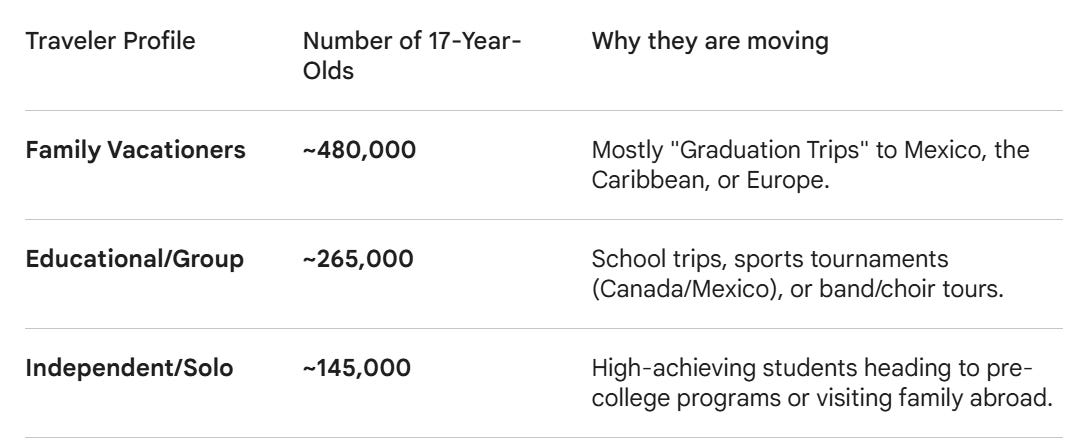
So of the 4 million 17-year olds, half of them have passports, and of those, half of them actually use them, and of those, half of them are on family vacations, or 10%.
The Benefits of Travel
Since you are a reader of this newsletter, you are probably a traveler, or you at least value the benefits of travel. After all, travel’s benefits include:
Cognitive & Brain Development
Emotional Intelligence & Mental Health
Career & Life Skills
Adaptability & Self-Reliance
Cultural Awareness & Stereotype Reduction
While this list is not exhaustive, it’s the famous Mark Twain quote that summarizes the benefit beautifully, written here in full from The Innocents Abroad, 1869.
"Travel is fatal to prejudice, bigotry, and narrow-mindedness, and many of our people need it sorely on these accounts. Broad, wholesome, charitable views of men and things cannot be acquired by vegetating in one little corner of the earth all one's lifetime."
Why US Citizens Don’t Travel
While I can’t come up with stats on why 17 years olds, in particular, don’t travel, I can come up with stats for why USA citizens don’t travel (source.)

I don’t think any of these statistics are necessarily shocking. Thus, let’s get to my dream.
My Dream
My dream is to give every 17 years old in the USA $5000 to travel and getting rid of the #1 reason people don’t travel, money (96% of them are USA citizens (source: USA Census).)
Here are the rules of that $5000.
They must use it for travel
They must travel further than they’ve ever traveled before.
If that’s the next county, fine.
If that’s the next state, fine.
If that’s the next country, fine.
If that’s the next continent, fine.
If that’s the next planet, fine.
They must do it before they turn 18.
They can take whomever they want with them, or go alone.
If they don’t have a passport, one will be provided.
They must use the entire $5000.
Or if they chose not to accept their one-time gift, it’s forfeited. The forfeited money goes toward invites of other 17-years olds in the world to visit the USA.
Costs of My Dream
The annual cost of this dream is $22 billion. That’s a lot of money.
Let’s look at other things that costs $22 billion
22 days of bombing Iran
The annual state budget of Louisiana
The FAA’s annual budget
The stopping of 22 windmill farms off the east coast
The value of 10% of America’s food waste annually
The Fed’s annual affordable housing budget.
The Outcomes of Teen-age Travel
Thus, does the cost of the dream return value to the 17-year olds who take advantage of it? Or in more business-focused terms, what’s the return on investment?
I admit, I put AI to the task on this one because I wanted to give data to my gut instinct that getting people to travel earlier in their lives would be beneficial to all of us. But let’s look at what AI returned on the ROI after just one year of the program.
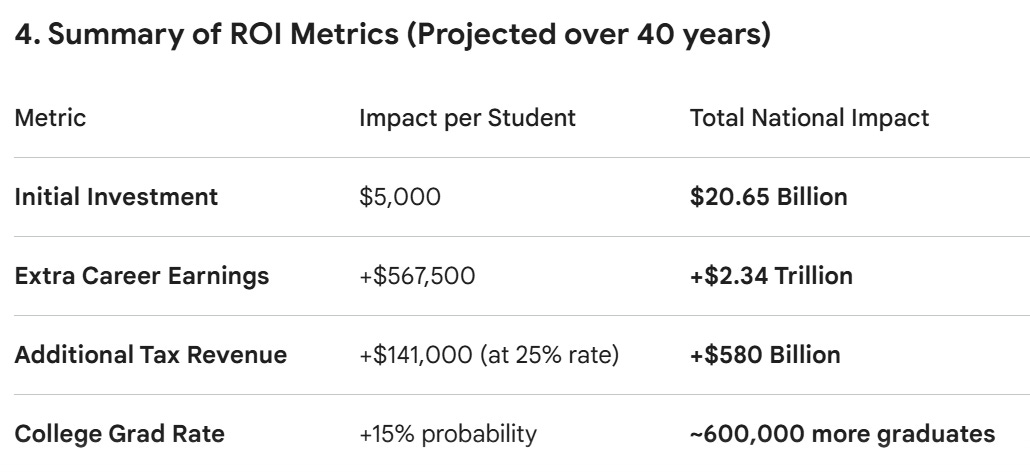
Based on longitudinal studies of student travel and 2026 economic data, here is the projected ROI.
1. Individual ROI: The “Earnings Premium”
The most direct ROI comes from the long-term impact on the students’ careers. Research from the WYSE Travel Confederation and various study abroad outcomes shows that “educational travel” in youth is a major predictor of future success.
Starting Salary Boost: Students who engage in significant travel during their teens earn roughly 12% more annually than their peers who don’t.
Lifetime Gain: For an average American worker, that 12% premium translates to an extra $567,500 in career earnings.
The ROI Math: For a one-time $5,000 investment, a $567k return is a 11,250% individual ROI.
2. Academic ROI: Retention and Graduation
Travel acts as a “high-impact practice” that keeps students engaged in their education.
College Completion: 17-year-olds who travel are 15% to 19% more likely to graduate from college within four years.
GPA Impact: International travel is linked to a 100% greater improvement in GPA post-trip compared to students who stayed home.
The “Drop-Out” Offset: Preventing just a small percentage of high school or college dropouts saves the government billions in lost productivity and social services over the long term.
3. Macro-Economic ROI: The “Stimulus Effect”
While the money is intended for the teens, it immediately enters the global and domestic economy.
Direct Spending: $20.65 billion injected into airlines, hotels, and local businesses creates a massive “multiplier effect.” Every $1 spent on travel typically generates $2.50 in total economic output.
Job Support: This level of spending would support approximately 175,000 to 200,000 jobs in the travel and hospitality sectors.
5. The “Intangible” ROI (Social Capital)
Mark Twain’s “fatal blow to prejudice” is hard to put a price tag on, but in 2026, social scientists track “Global Competency.”
Conflict Reduction: High-travel populations show higher levels of tolerance and lower susceptibility to radicalization or extreme nationalism.
Skill Acquisition: 96% of young travelers report increased self-confidence, and 80% report a better ability to adapt to diverse work environments—the #1 skill requested by U.S. employers in 2026.
The Verdict: If you look at it strictly as a “Taxpayer Investment,” the government would break even on the $22 billion within about 12–15 years through the increased tax revenue from higher-earning citizens. After that, it becomes pure profit for the national treasury.
Let’s extrapolate the one year costs of a one-year program out to an annual cost, and here’s what AI returns.
1. The “Snowball” Effect on National Productivity
In the one-time scenario, you get a single “bump.” In the annual scenario, you are adding roughly 4 million highly-skilled, travel-exposed workers to the economy every single year.
By Year 10: You have 40 million workers in the prime of their careers who possess higher “Global Competency” scores.
Economic Output: Based on the 12% earnings premium, the cumulative addition to the U.S. GDP would move from billions into the trillions within two decades.
2. Tax Revenue vs. Program Cost
An annual $22 billion program is expensive, but it eventually pays for itself through “tax recapture.”
The Break-Even Point: Since each traveler eventually pays roughly $140k more in lifetime taxes (due to higher earnings), the government “recoups” the $5,000 investment many times over.
The Surplus: By the time the first “Grant Class” hits age 35, their increased tax contributions would likely cover the cost of the current year’s 17-year-olds, making the program fiscally self-sustaining in the long run.
3. Industry Stability (The Travel Sector)
For the travel industry, an annual $22 billion injection is a “guaranteed floor.”
Infrastructure: Airlines and hotels could build long-term capacity knowing that 4 million “new customers” are entering the market every June.
Lowering Costs: This massive, predictable demand would likely allow for “bulk-buy” government rates on flights and hostels, potentially lowering the cost per student from $5,000 to $3,500, saving the treasury billions.
Now, I am not an economist, I am not a data analyst, and I am certainly not an AI specialist. I am just someone with a dream.
If you find value in this dream, please let me now. Would you support it? Would you write a business plan for it? Or, if anything else, would you answer the poll?
I LOVE this idea 💡!!! Englert for PRESIDENT!
This is a dream of BHAG proportions Chris. I'm in favor!