

I really wanted my research on reposition cruises to come out in my favor. Afterall, we’re big fans of repositioning cruises, and you’ll often find us on two a year. I decided to look into the pollution and carbon footprints of repositioning cruises compared to the same amount of resources a couple might use for the equivalent amount of time and travel to see how the environmental comparison fared.
What’s a Repo Cruise?
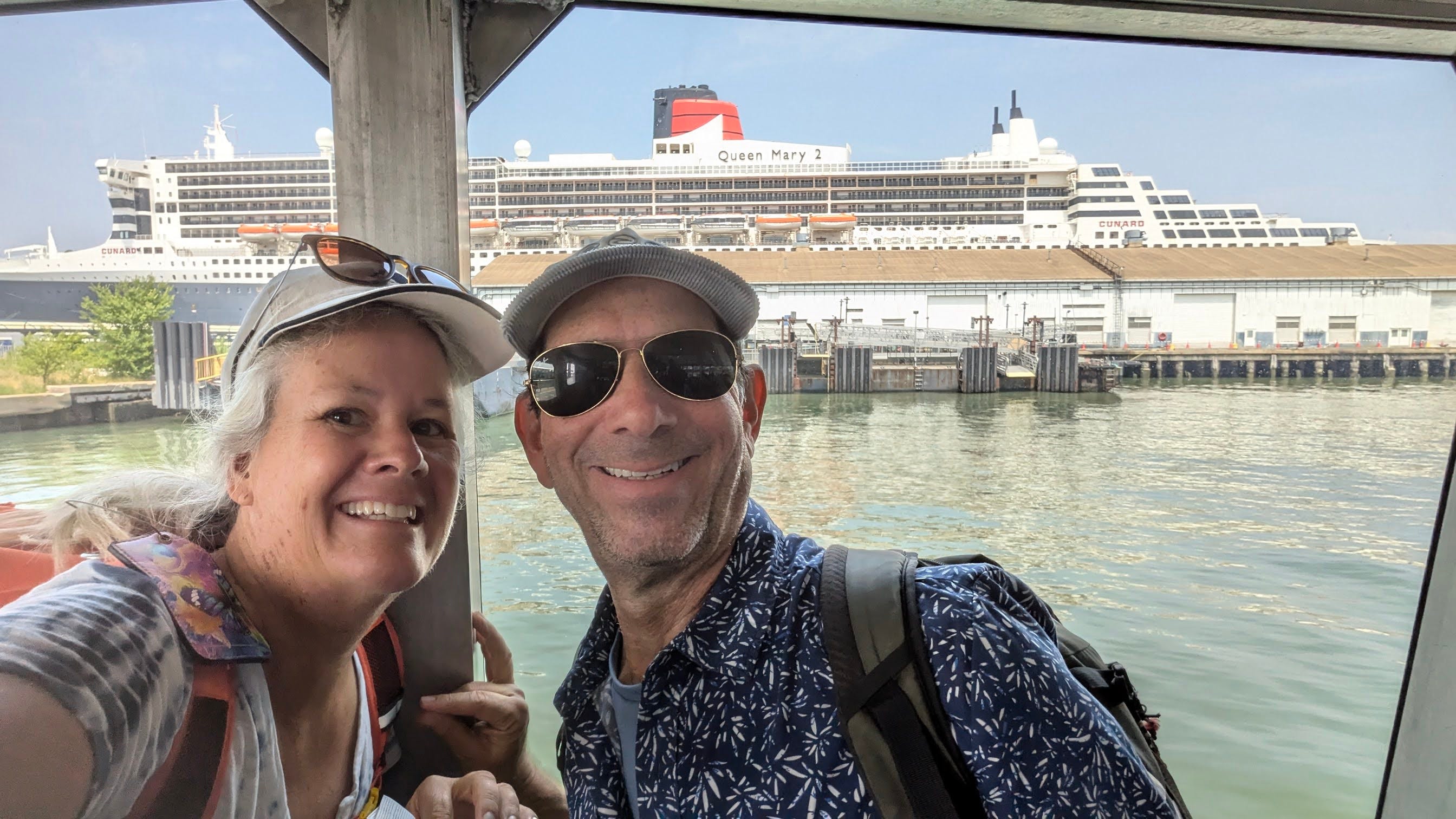
Let’s start with some definitions first. A repositioning cruise is a one-way trip on a cruise line, usually in April and October, when the cruise industry moves its entire fleets from one market to the next. So, for example, the ships move from the summer Mediterranean market to the winter Caribbean market or the Mexican market moves to the Alaskan market. Cruise ships follow the good weather just like we do. So when a cruise ship moves, it’s a probably simultaneous when we move continents.
Why Take Repos?
We like repositioning cruises. They’re a fun way to get us from one continent to the other at a much slower place, eliminating the need to fly. We’ve crossed the Atlantic from Europe to the Americas and back at least four times, from the Americas to Australia and back two times, and across the Pacific from Asia to the Americas twice. Each cruise has been at least 15 days, and the longest was 29.
Along the way, we’ve stopped in countries we wouldn’t normally put on our list to see including Cape Verde, American Samoa, and Fiji. We’ve had mostly smooth seas, although one cruise had us bobbing in 30 foot waves. Friends have joined us often, and we’ve made friends several times. We’ve even won the ship’s Boat Building Competition.


Repo Boot Camp
Steve and I have learned how to really take advantage of the ships. Afterall, we’re transiting, not vacationing, when we reposition. Thus, we’ve eaten the salads, passed on the desserts, used the gym daily, easily walked our 12,000 steps, and climbed our 10 flights of stairs daily. We see repositioning cruises as a way to recommit to our health and fitness goals. It’s Repo Boot Camp for us.
How Dirty Is Dirty?
After reading several pieces about how dirty and polluting the cruise industry is despite the world watchdogs’ attempts to make them play clean (source), I looked askew. Were the data points taking into my unique nomad lifestyle, and if I could find a way to look at the pollution data from my Nomad Life point of view, would I come up with different results?
I started by looking at just a vacation scenario of a 7-day Caribbean cruise out of Miami versus the same destinations via flying and hopping from island to island. I don’t think many people who go to the Caribbean via a flight hop from island to island (my gut is that they stay in resorts), but I wanted an apples to apples comparison. I asked Gemini, and these are the results.
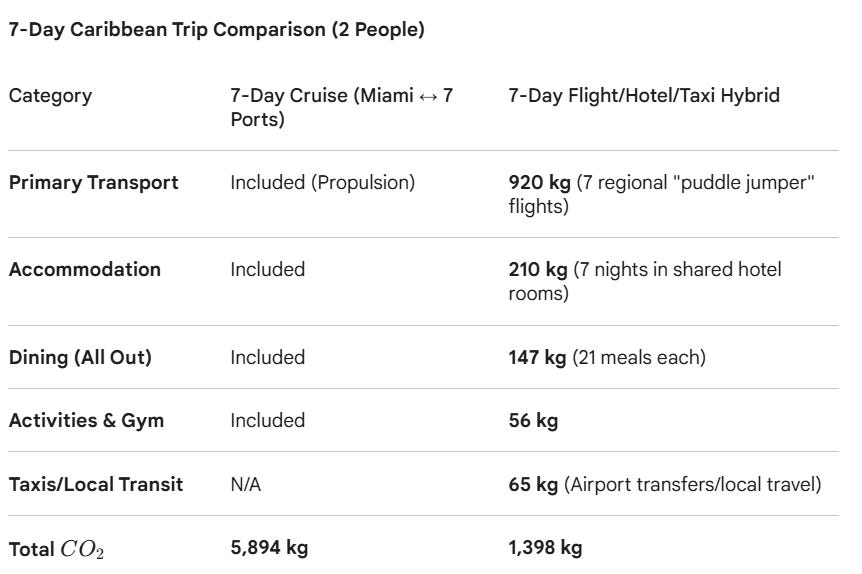
The conclusion: A cruise is almost 4 times dirtier than a flight-hotel-taxi scenario.
I then did the exact comparson for a repo from Cape Canaveral to Barcelona with stops in the Bahamas, the Azores, the Canaries, and two spots in Spain. Gemini returned these results.
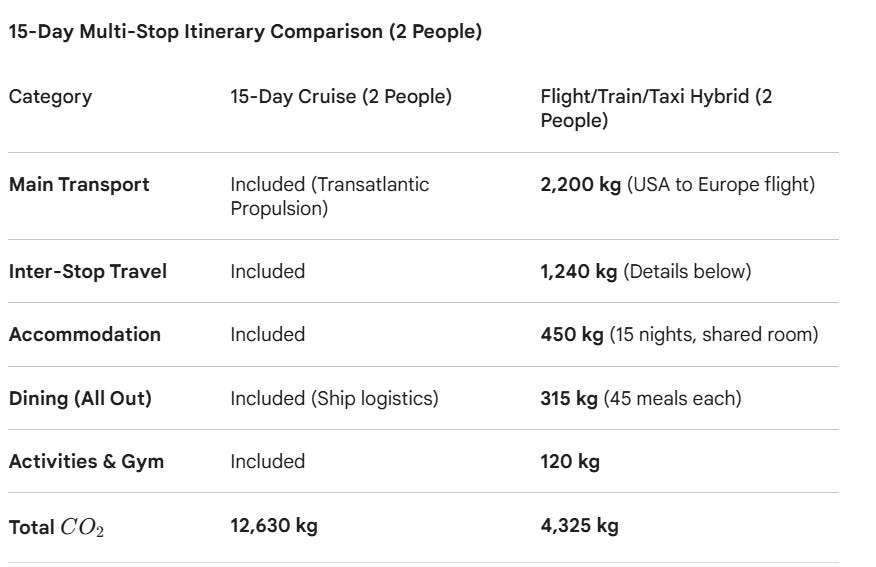
The conclusion of the repo: it’s 3 times as dirty, but not as dirty as the 7-day vacation. I don’t mention this as a consolution price, just an interesting comparison that emphasizes the positives of slower perpulsed travel. But I concede, it’s not clean in any way.
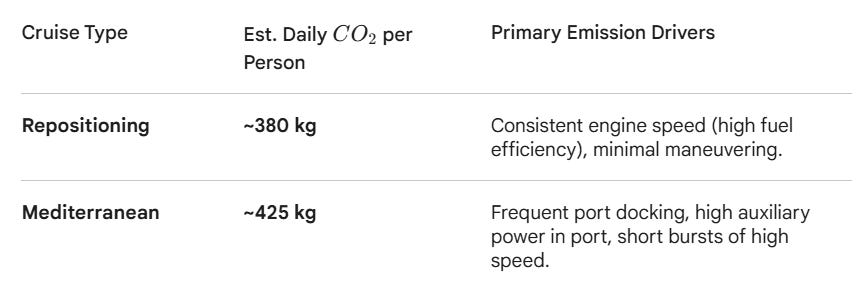
So where does that leave us as we look to our future travel? While I’d like to say that I’m completely focused on my carbon footprint, I am not. Yet I do eat vegan/vegetarian, buy recycled clothing, walk/bike/transit instead of own a car, move slowly, carry a refillable bottle and reusable spork, travel light, and of course, turn lights off when I’m not using them, I could always do better.
Retired vs Nomad Life Retired
I decided to look at my current life style versus what it could have looked like if we’d retired in Denver as typical retirees who travel globally for vacation and visit friends/family throughout the year. Frankly, it’s hard to imagine exactly what that life would look like since we’re not doing it, so I made a few assumptions. There’s a slight win for the Nomad Life, but I think assumptions could be configured to make the comparisons come out equal. I also allowed for only one car, but I could imagine having two, easily.
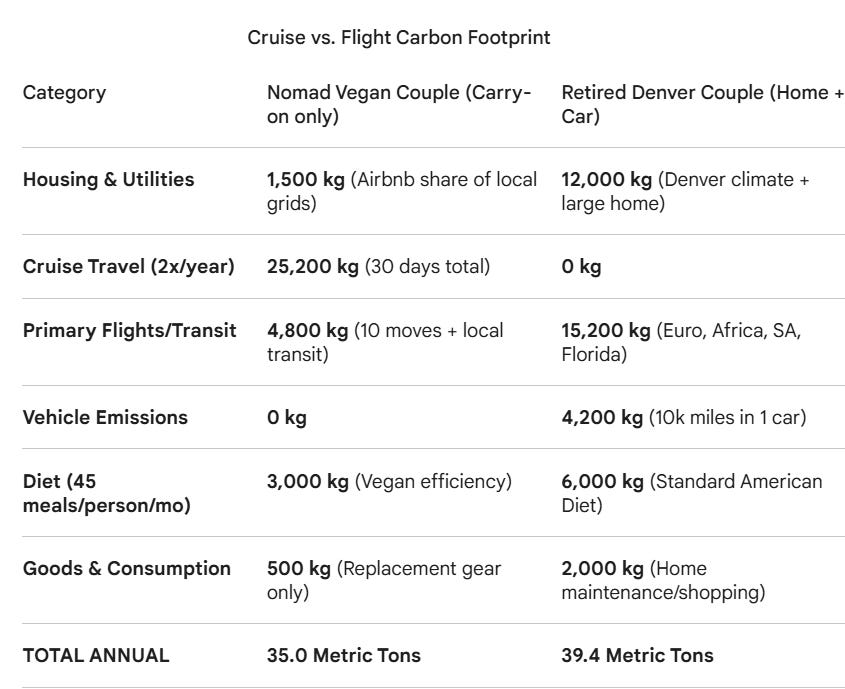
By looking at these two different lifestyle and factoring in the dirty truth of the repo cruises, I’m still living a “cleaner” life (or least it’s not dirtier) than a traditional life of a home-owning couple. So what’s all of this mean?
It makes me think, at least, about how I could do better. I can tell you I’m not about to jump into a sailboat and go carbon-free. And after investigating options to buy down my carbon footprint, I’ve concluded the same that Erin, Nomad Life did in her article.
Monitor. Comment. Watch closely.
A special thank you to Erin, Nomad Life for inspiring this article.
I’m curious why diet is not a controlled variable across the comparison between staying home and cruising. In other words, for the comparison to be fair diet should be the same (vegan or standard American, doesn’t matter which) in both cases, to eliminate that as a consideration. 🤔
One could make a convoluted justification that for repo cruises in particular the ships are going anyway … so you’re just catching a ride … maybe? Are these repo cruises usually sold out?