

I’m guilty. Super guilty. As a light packer with a single carry-on that holds everything I own in the world, I must make hard decisions about the space inside my bag. When I need a new item, an old item must come out of my bag.
Many times that old item makes it to a charity shop on my own accord. But sometimes, it doesn’t because I was 1) out of time 2) couldn’t find a shop 3) a shop wasn’t available (hours, location, etc) 4) I’m lazy.
I’ve Left Items Behind
I’ve placed the clean item neatly on the hotel bed with a note that says “trash.” My intention is that the maid sees my snorkel, shirt, or shoes, and hopefully takes the item for her own rather than logs it into the hotel’s tracking system as a forgotten item. I’ve done the same with my cabin steward on cruise ships as well.

I’m sure there are many other iterations of this behavior by travelers world wide, such as: when the luggage is overweight and someone leaves a shirt “for the janitor”, when packing for the return home and the souvenirs fit but the old pants don’t, when changing temperatures on a long trip and the puffer jacket “might help out the locals.” Have you done any of these?
An article from Tim Wenger writing at Matador Network in his piece My Dirtiest Travel Habit Has a Name made me question this habit, and I dug deep into Gemini AI to find some data. I also found a partial solution.
The Data Doesn’t Support the Habit
I did a bit of research about Tim’s dirty habit and also my own, and I uncovered data that screams “bad traveler” at me.
Although I write a note that says “Trash” most hotels won’t accept that note. What if I was drunk? What if my spouse was taking refenge? What if I call the hotel three days later and said I was joking? Despite the note, the maid must still catalog and put the item into the hotel’s tracking software. (Cornell)
Maritime law has strict rules regarding “abandoned” property and crew members, like my dear cabin steward, can’t simply take things off ships. (Carnival Contract, CPB)
Chargerback claims that a typical hotel of 200-300 rooms reports over 100 items lost a month, weighing over 2000 pounds (one ton) per year per hotel.
A typical cruise ship reports over 500 items “lost/forgotten/abandoned” a week or 40,000 pounds a year. (Lostings)
A branded hotel of 200-300 rooms spends upwards of 3000 hours and $60,000 in tracking, storing, managing, laboring of these abandoned items annually. (Vingcard)
So by leaving my “trash”, I’ve unintentionally generated yet more work for an employee who is likely overworked, underpaid, and stressed. Clearly, this is not my intention. My intention is to provide a dress, a jacket, or a pair of shoes that I think she may need or might be able to make a few extra dollars on a sale or trade with a collegue.
Oops.
A Partial Solution
(Let me state that the best solution is to not buy the new thing in the first place.)
The best option is to do like we generally try to do: donate the item to a charity shop. The other option, according to Executive Housekeepers, is to write a note that says, “These blue Nike shoes are a gift to you. If you cannot use them, please give to a collegue or donate to charity.” By writing such a note that specifies the exact item (instead of “trash”), she may actually be able to keep the item and not get fired for pocketing a guest’s personal item. The note acts as a pass the finder can use if she’s asked about how she came upon the item. It should say these four items.
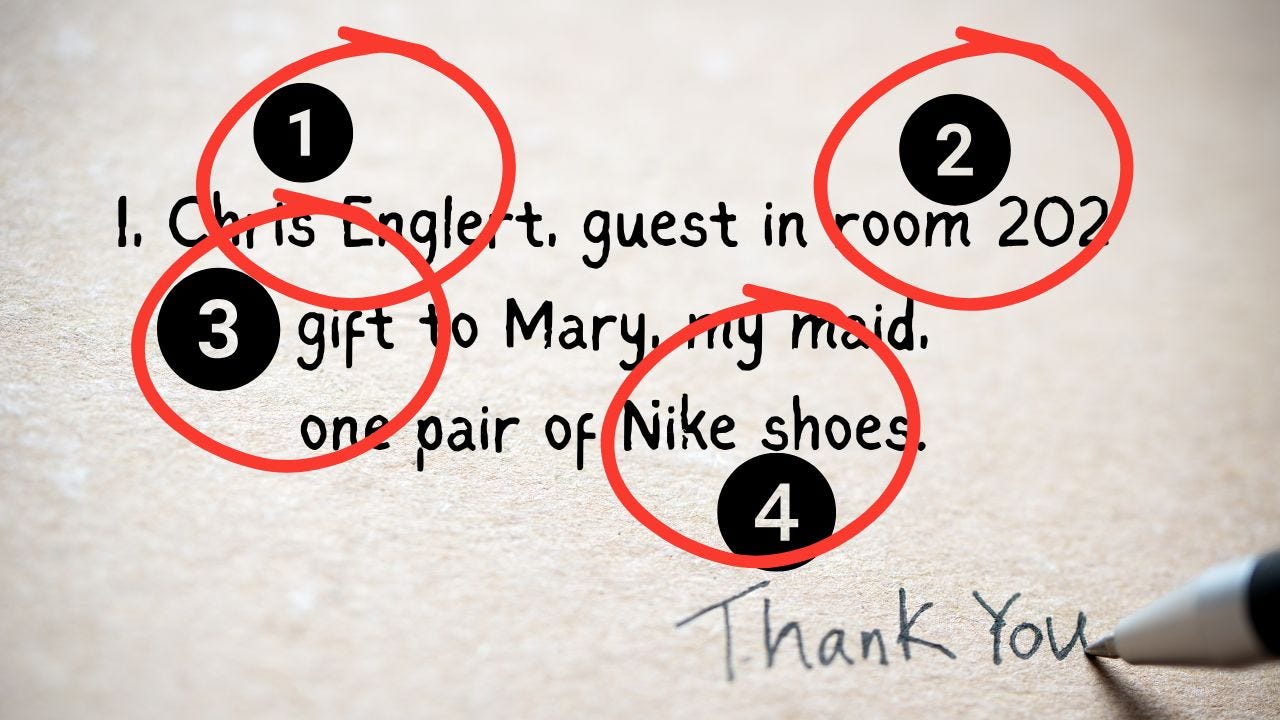
Now that I know what a headache I’m causing, I’ll either make more effort to find the charity shop, or I’ll clearly write a note about my intention. Will you? Thoughts?
Chris
P.S. My new book which comes out in two weeks is based on the true story of me forgetting my Kindle in Bucharest. Thank heavens when I called the hotel, a little boutique inn with no formal tracking systems, and they found it. But it took two calls.

Founding Members get personal time with me.
Paid members get voting rights.
I was in a shop today, and I asked the employee who was helping me if she knew of charity shops where I could donate, explaining that if I bought something in her shop, I would need to make room in my luggage by donating something I brought. She very helpfully described the location of a charity organization near the train station.
Thought-provoking. You're so right with the "don't buy it in the first place".